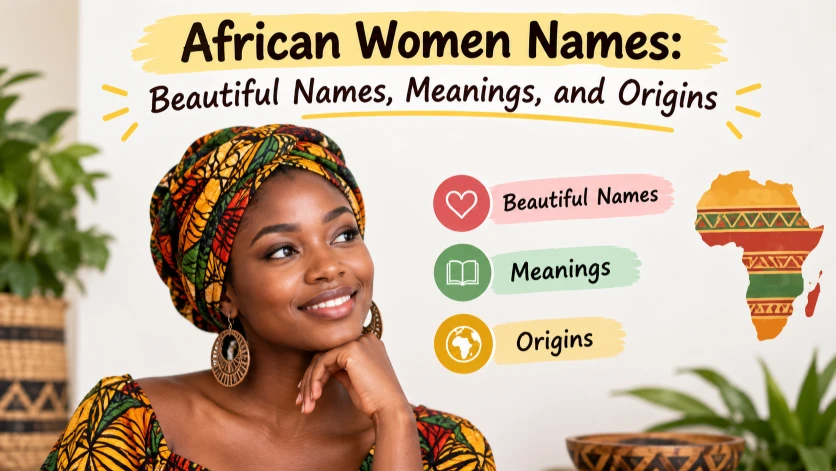
African women names come from hundreds of languages and cultures across the continent, so there is no single “African naming style.”
Names from Yoruba, Igbo, Akan, Zulu, Xhosa, Swahili, Amharic, Shona, Tswana, Somali, and many other traditions can reflect faith, family, birth circumstances, joy, strength, beauty, gratitude, or hopes for a child.
This guide brings together African women names with their meanings and cultural or language origins. It also explains how African naming traditions differ, so you can choose a name based on meaning and heritage rather than sound alone.
What Are African Women Names?
African women names are female or feminine names used in African cultures and languages. They can come from West, East, Central, North, or Southern Africa, with each region containing many distinct naming traditions.
For example, Yoruba names may express family circumstances or joy, while Akan names can reflect the day of birth. Zulu and Xhosa names may describe circumstances surrounding a child’s arrival or qualities associated with the child.
Because Africa has enormous linguistic and cultural diversity, it is more accurate to identify a name by its specific language or cultural tradition rather than simply calling it “African.”
Beautiful African Women Names With Meanings
Here are some African feminine names from different linguistic traditions:
| Name | Meaning | Origin |
| Abena | Born on Tuesday | Akan |
| Abeni | We prayed and we received | Yoruba |
| Aberash | Giving off light; shining | Amharic |
| Adaeze | Eldest daughter of the king | Igbo |
| Adanna | Eldest daughter of the father | Igbo |
| Adenike | The crown is to be cared for | Yoruba |
| Afua | Born on Friday | Akan |
| Akosua | Born on Sunday | Akan |
| Amani | Peace | Swahili |
| Ayanda | They are increasing | Zulu/Xhosa/Ndebele |
| Ayomide | My joy has arrived | Yoruba |
| Babirye | First of twins | Luganda |
| Bolanle | Find wealth at home | Yoruba |
| Bontle | Beautiful | Tswana |
| Busisiwe | Blessed | Zulu/Xhosa |
| Ebere | Mercy; kindness | Igbo |
| Esi | Born on Sunday | Akan |
| Enyonam | It is good for me | Ewe |
| Fadzai | Please; make happy | Shona |
| Folasade | Rule with nobility | Yoruba |
| Funmilayo | Give me joy | Yoruba |
| Furaha | Joy; happiness | Swahili |
| Ijeoma | Good journey | Igbo |
| Imani | Faith | Swahili |
| Jabulile | We have rejoiced | Zulu |
| Kamaria | Moon | Comorian |
| Kagiso | Peace | Tswana |
| Nia | Purpose | Swahili |
| Zola | Quiet; tranquil | Various African usage |
Meanings can vary by language, spelling, and source, so a name should be checked against its specific linguistic tradition before being treated as having one universal meaning.
African Girl Names by Culture and Language
Yoruba Women Names
Yoruba names are strongly connected to family, circumstances, beliefs, and hopes. Many names contain meaningful elements rather than functioning as arbitrary labels.
Some examples include:
- Abeni: we prayed and we received
- Adenike: the crown is to be cared for
- Bolanle: find wealth at home
- Folasade: rule with nobility
- Funmilayo: give me joy
- Iyabo: mother has returned
- Ayomide: my joy has arrived
- Ayodele: joy has come home
- Eniola: person of wealth
Yoruba naming has also been studied as an important part of social and cultural identity. Historical and linguistic research shows that naming can reflect birth circumstances, family relationships, and cultural values.
Igbo Women Names
Igbo names often carry clear messages about family, faith, gratitude, or a child’s place within the family.
Examples include:
- Adaeze: eldest daughter of the king
- Adanna: eldest daughter of the father
- Adannaya: eldest daughter of her father
- Ebere: mercy or kindness
- Ijeoma: good journey
- Fumnanya: love me
- Ebele: a variant of Ebere
Igbo naming traditions have also been examined by linguists because personal names can encode cultural and religious ideas.
Akan Women Names
Akan naming traditions are especially known for day names. The name can indicate the day on which a child was born.
Some feminine examples include:
- Adwoa: Monday-born
- Abena: Tuesday-born
- Akua: Wednesday-born
- Yaa: Thursday-born
- Afua: Friday-born
- Ama: Saturday-born
- Akosua: Sunday-born
- Esi: Sunday-born
The exact spelling can vary among Akan communities and languages. The day-name system is well documented in Ghanaian naming traditions.
Zulu and Xhosa Women Names
Zulu and Xhosa names can describe experiences, circumstances, qualities, or hopes connected with a child’s life.
Examples include:
- Ayanda: they are increasing
- Ayabonga: they are thankful
- Busisiwe: blessed
- Jabulile: we have rejoiced
- Buhle: beautiful
- Enzokuhle: to do good
Research on Zulu personal naming practices shows that names can point to people, circumstances, and social experiences surrounding a child’s birth and life.
Swahili Women Names
Swahili names are found across several East African communities and can have Arabic influence as well as local linguistic roots.
Popular examples include:
- Amani: peace
- Furaha: joy or happiness
- Imani: faith
- Bahati: luck or good fortune
- Eshe: a variant of Asha
Swahili naming is especially useful to consider separately from a broad “African” category because Swahili is a specific language with its own history and vocabulary.
Amharic Women Names
Amharic is one of the major languages of Ethiopia and has its own naming traditions.
Examples include:
- Abeba: feminine form of Abebe
- Aberash: giving off light; shining
- Etenesh: you are my sister
These names should be understood within Ethiopian and Amharic linguistic contexts rather than treated as generic African names.
Shona Women Names
Shona is widely spoken in Zimbabwe and neighboring areas.
Examples include:
- Fadzai please; make happy
- Farai rejoice; be happy
- Danai related to “call” or “summon”
Tswana and Sotho Women Names
Southern African naming traditions also offer names connected with joy, beauty, peace, and other qualities.
Examples include:
- Bontle: beautiful
- Boitumelo: joy
- Kagiso: peace
- Bonolo: ease
- Karabo: answer
African Women Names Meaning “Beautiful”
If you want a name connected with beauty, a few options are:
- Bontle: beautiful, from Tswana
- Buhle: beautiful or handsome, from Xhosa/Ndebele
- Aberash: associated with shining or giving off light, from Amharic
- Adenike: a Yoruba name connected with the crown and care
A name that means “beautiful” does not always refer only to physical appearance. In many naming traditions, names can express qualities, hopes, relationships, or circumstances.
African Women Names Meaning “Joy”
Names connected with happiness and joy include:
- Ayomide: my joy has arrived
- Ayodele: joy has come home
- Funmilayo: give me joy
- Furaha: joy or happiness
- Jabulile: we have rejoiced
- Boitumelo: joy
- Farai: rejoice or be happy
These examples come from several different languages, showing why it is useful to identify a name’s specific origin.
African Women Names Meaning “Faith” or “Peace”
For a name with a spiritual or peaceful meaning, consider:
Faith
Imani is a Swahili name meaning “faith.” It ultimately comes from an Arabic word connected with faith or belief.
Peace
Amani is a widely used Swahili name meaning “peace.”
Kagiso is a Tswana name meaning “peace.”
These meanings make the names suitable for parents or writers looking for names connected with calmness, belief, or hope.
African Women Names Meaning “Blessing”
Several African naming traditions contain names associated with blessings or gratitude.
Examples include:
- Busisiwe: blessed, Zulu/Xhosa
- Abeni: we prayed and we received, Yoruba
- Ese: gift, Urhobo
- Eseoghene: God’s gift, Urhobo
- Bahati: luck or good fortune, Swahili
The exact meaning matters because words such as “blessing,” “gift,” and “gratitude” may come from different linguistic and cultural ideas.
Rare and Unique African Women Names
If you want something less familiar, consider names such as:
- Abeni
- Aberash
- Adaeze
- Enyonam
- Folasade
- Fadzai
- Ijeoma
- Jabulile
- Kamaria
- Bontle
“Rare” should be used carefully, however. A name may be uncommon internationally while being familiar within its home community. Reliable worldwide popularity data is limited for many African names.
Short African Women Names
Short names can be easy to spell and remember.
Some options include:
| Name | Origin | Meaning |
| Ayo | Yoruba | Joy |
| Esi | Akan | Born on Sunday |
| Ama | Akan | Saturday-born |
| Yaa | Akan | Thursday-born |
| Nia | Swahili | Purpose |
| Amani | Swahili | Peace |
| Buhle | Xhosa/Ndebele | Beautiful |
| Furaha | Swahili | Joy; happiness |
Short does not mean culturally simple. Even a short name can carry a detailed history or important family meaning.
Strong African Women Names
If you want a name that suggests strength, dignity, or resilience, consider:
- Adaeze: eldest daughter of the king
- Folasade: rule with nobility
- Adenike: the crown is to be cared for
- Imani: faith
- Kagiso: peace
- Bontle: beautiful
- Ayanda: they are increasing
The idea of a “strong” name is subjective. A name can feel strong because of its meaning, cultural history, sound, or personal connection.
How African Naming Traditions Differ
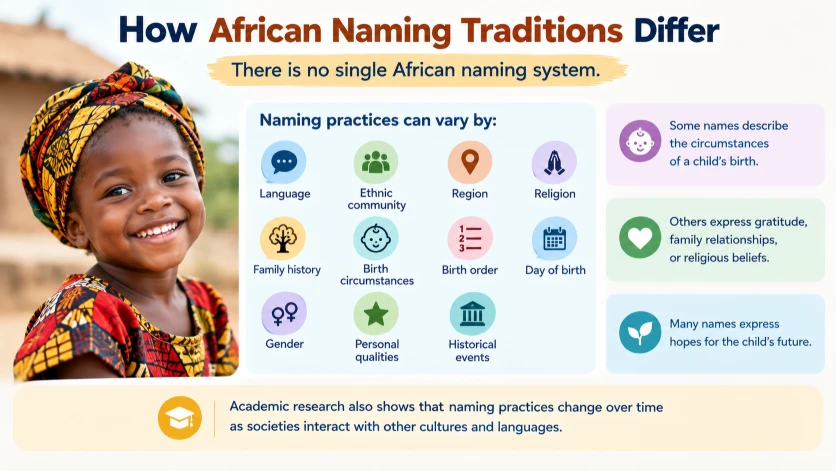
There is no single African naming system.
Naming practices can vary by:
- Language
- Ethnic community
- Region
- Religion
- Family history
- Birth circumstances
- Birth order
- Day of birth
- Gender
- Personal qualities
- Historical events
Some African names describe the circumstances surrounding a child’s birth. Others express gratitude, family relationships, religious beliefs, or hopes for the child’s future. Academic research also shows that naming practices change over time as societies interact with other cultures and languages.
Are African Women Names Only Used in Africa?
No. African-origin names are also used by people in African diaspora communities around the world.
However, a name’s use outside Africa does not erase its original linguistic or cultural background. When choosing a name for cultural reasons, it is useful to learn:
- Which language it comes from
- Which community uses it
- What its meaning actually is
- How it is pronounced
- If the spelling has changed
- If the name has a specific cultural context
This approach helps avoid treating Africa as one single naming culture.
How to Choose an African Woman’s Name
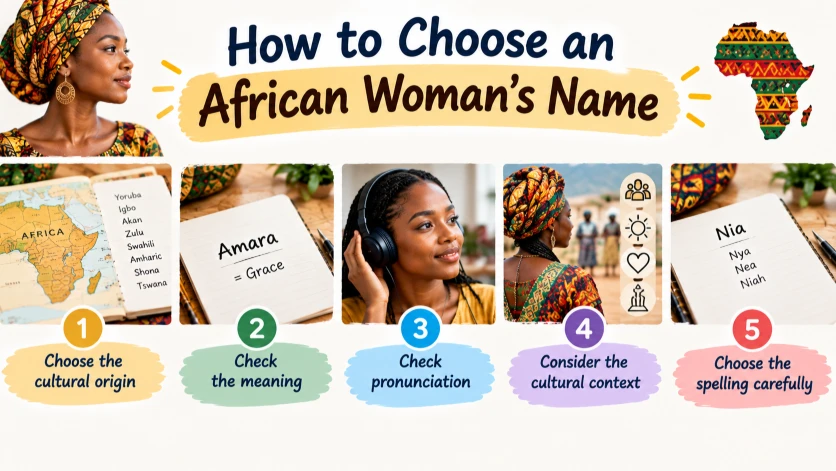
If you are choosing a name for a baby, character, brand, username, or another purpose, start with the meaning you want.
1. Choose the cultural origin
Instead of searching only for “African names,” decide if you want a Yoruba, Igbo, Akan, Zulu, Swahili, Amharic, Shona, Tswana, or another tradition.
2. Check the meaning
Make sure the meaning comes from a reliable source and matches the specific language.
3. Check pronunciation
A name may look simple in English but have sounds that work differently in its original language.
4. Consider the cultural context
Some names have specific connections to birth circumstances, family roles, religion, or community traditions.
5. Choose the spelling carefully
Romanization can produce different spellings. When possible, preserve the established spelling used by the name’s community.
Common Mistakes When Choosing African Names
Treating Africa as One Culture
Africa contains many nations, languages, ethnic groups, and naming systems. Calling every name simply “African” can hide its actual origin.
Assuming Every Name Has One Meaning
Meanings can differ between languages, dialects, spellings, and sources.
Using an Unverified Name Meaning
Popular name websites sometimes repeat meanings without showing their linguistic basis. Check the source before publishing or choosing a name.
Confusing African Names With African-American Names
African-origin names and names used in African-American communities overlap in some cases, but they are not automatically the same category.
Ignoring Pronunciation
A name should be checked in its original linguistic context rather than pronounced only according to English spelling.
Frequently Asked Questions
What Are Some Black African Names?
Black African names vary widely by country and culture. Some examples include Amina, Zuri, Amara, Imani, Nia, Ayana, Adaeze, and Zola.
What Is a Good Name for an African Girl?
Good African girl names include Amara, Zuri, Amina, Imani, Nia, Ayana, and Adaeze. The best choice depends on the specific African culture or language you want to represent.
What Are Rare Black Girl Names?
Some less common choices include Nkiruka, Adesewa, Ezinne, Sade, Makena, Zuberi, and Eshe. Their meanings and cultural backgrounds vary.
What Are the Top 10 Black Girl Names?
There is no single official top 10 for Black girl names because naming trends differ across African countries and the global African diaspora. Popular choices include Amina, Amara, Zuri, Imani, Nia, Ayana, Nia, Maya, Aaliyah, and Naomi.
What Is a Super African Name?
A “super African name” can mean a name that strongly reflects a particular African language or culture. Examples include Adaeze (Igbo), Adebayo (Yoruba, traditionally masculine), Nia (Swahili), and Makena (Kenyan usage).
What Are Some Nigerian Girl Names?
Popular Nigerian girl names include Adaeze, Adesewa, Yetunde, Folake, Chioma, Chiamaka, Ezinne, Ifeoma, Temilade, and Simisola. Many Nigerian names have meanings connected to family, faith, gratitude, beauty, or circumstances surrounding birth.
Conclusion
African women names offer far more variety than a single list can show. Yoruba, Igbo, Akan, Zulu, Xhosa, Swahili, Amharic, Shona, Tswana, and many other traditions have their own naming patterns and meanings.
If you are choosing a name, focus first on cultural origin, meaning, pronunciation, and context. A name such as Imani may express faith, Amani may represent peace, Ayomide may express joy, and Adaeze may reflect family status.
The most meaningful choice is one whose history and meaning genuinely fit what you are looking for.
READ MORE!
Unique Boy Names: 100 Distinctive Ideas With Meanings

I’m passionate about names, their meanings, origins, and cultural connections. I research naming trends and traditions to help readers discover unique, meaningful, and memorable names.







2 thoughts on “African Women Names: Beautiful Names, Meanings, and Origins”