
Tattoo placement names are the terms used to describe the exact part of the body where a tattoo is placed.
Common names include forearm, wrist, upper arm, shoulder, chest, ribs, back, thigh, calf, ankle, neck, and foot. Many areas also have more specific names, such as inner forearm, outer forearm, shoulder blade, collarbone, sternum, nape, and inner thigh.
Knowing these names makes tattoo planning much easier. You can use them when searching for tattoo ideas, explaining your design to an artist, comparing visibility, or deciding if a tattoo should be easy to hide.
Placement also affects how a design fits the body. A long design may suit the forearm or calf, while a wider composition may need the chest or upper back. Small designs can work in compact areas such as the wrist, ankle, or behind the ear. Tattoo-placement guides commonly recommend matching the size and shape of the artwork to the body’s natural contours.
This guide explains the main tattoo placement names, their common sub-areas, and what to consider before choosing one.
Tattoo Placement Names: Quick Answer
Here are the most common tattoo placement names:
- Arm: upper arm, bicep, tricep, forearm
- Wrist: inner wrist, outer wrist
- Hand: back of hand, palm, fingers, knuckles
- Shoulder: shoulder cap, front shoulder, back shoulder
- Chest: upper chest, center chest, sternum
- Back: upper back, mid-back, lower back, spine, shoulder blade
- Neck: front neck, side neck, back of neck, nape
- Ribs: side ribs, rib cage
- Abdomen: upper stomach, lower stomach, side waist
- Leg: thigh, knee, calf, shin
- Ankle: inner ankle, outer ankle, front ankle
- Foot: top of foot, side of foot, ankle-to-foot area
- Ear area: behind the ear, ear cartilage
The exact wording can vary between tattoo studios and artists. If you are unsure, showing the artist a photo and marking the desired area is often clearer than relying on a name alone.
What Are Tattoo Placement Names?
Tattoo placement names are simply body-area terms used to identify where tattoo artwork will go.
For example:
“I want this tattoo on my inner forearm.”
That gives an artist much more information than saying:
“I want it on my arm.”
The second description covers a large area. The first identifies a more precise location.
Tattoo placement can also be described using directional terms:
- Inner means toward the inside of a limb or body area.
- Outer means toward the outside.
- Front means the forward-facing side.
- Back means the rear-facing side.
- Upper means closer to the head.
- Lower means farther from the head.
- Side identifies a lateral area.
- Center identifies the middle of an area.
These terms help narrow down the exact placement.
Tattoo Placement Names by Body Part
1. Arm Tattoo Placement Names
The arm offers several distinct tattoo locations.
Common names include:
- Upper arm
- Bicep
- Inner bicep
- Outer upper arm
- Tricep
- Forearm
- Inner forearm
- Outer forearm
- Elbow
- Elbow ditch
The forearm is a long surface that can suit text, symbols, flowers, geometric designs, and vertical artwork. The upper arm gives more room for larger designs and can also be incorporated into a sleeve.
2. Wrist Tattoo Placement Names
The wrist is a smaller placement area.
Common terms include:
- Inner wrist
- Outer wrist
- Top of wrist
- Wrist side
Short words, initials, dates, and small symbols are often considered for this area because the available surface is limited.
3. Hand Tattoo Placement Names
For more specific hand tattoo placement terms, consider:
- Back of hand
- Palm
- Side of hand
- Finger
- Knuckle
- Finger side
- Thumb area
Hand tattoos are highly visible and exposed to frequent movement and everyday use. The exact design and size therefore matter.
4. Finger Tattoo Placement Names
Specific finger placements include:
- Top of finger
- Side of finger
- Finger joint
- Knuckle
- Finger webbing
Because these are small areas, simple designs generally provide more usable space than highly detailed artwork.
5. Shoulder Tattoo Placement Names
Shoulder placement can include:
- Shoulder cap
- Front shoulder
- Outer shoulder
- Back shoulder
- Shoulder blade
The rounded shape of the shoulder can influence how circular or curved artwork sits on the body. Artists often consider the body’s contour when positioning the design.
6. Chest Tattoo Placement Names
Common chest placement terms include:
- Upper chest
- Center chest
- Left chest
- Right chest
- Sternum
- Under collarbone
- Pectoral area
A chest tattoo can be small and simple or form part of a larger composition.
The sternum refers to the breastbone in the center of the chest. It is more precise than simply saying “middle of the chest.”
7. Collarbone Tattoo Placement
The collarbone, or clavicle area, is a recognizable placement for horizontal designs and short lettering.
You may also hear:
- Along the collarbone
- Under the collarbone
- Above the chest
- Collarbone side
The exact placement should follow the individual’s anatomy rather than a fixed measurement.
8. Back Tattoo Placement Names
The back provides a large canvas.
Common names include:
- Upper back
- Mid-back
- Lower back
- Full back
- Spine
- Shoulder blade
- Between the shoulder blades
- Upper back side
A central design may follow the spine, while a wider design can extend across the upper back.
The large surface also makes the back useful for artwork that may expand later.
9. Neck Tattoo Placement Names
Neck tattoos can be described as:
- Front neck
- Side neck
- Back neck
- Nape
- Under the jaw
- Behind the ear and neck area
The nape generally refers to the back of the neck.
Neck tattoos are usually highly visible unless clothing or hair covers the specific location.
10. Rib Tattoo Placement Names
The torso sides are commonly called:
- Ribs
- Rib cage
- Side ribs
- Upper ribs
- Lower ribs
The ribs create a curved surface. Designs may need to follow that curve rather than being positioned like artwork on a flat page.
11. Stomach and Abdomen Placement Names
Common terms include:
- Upper stomach
- Lower stomach
- Abdomen
- Side abdomen
- Waist
- Lower abdomen
The abdomen changes shape with posture and movement. Discuss the final size and orientation with the artist before deciding on a precise placement.
12. Hip Tattoo Placement Names
Hip-area tattoos may be described as:
- Hip
- Side hip
- Front hip
- Hip bone area
- Upper hip
The exact location can overlap with the side waist or upper thigh, so a reference photo can help avoid confusion.
13. Thigh Tattoo Placement Names
The thigh has several possible locations:
- Front thigh
- Outer thigh
- Inner thigh
- Back thigh
- Upper thigh
- Side thigh
The thigh provides more space than many small placement areas, making it suitable for larger designs.
14. Knee Tattoo Placement Names
Common terms include:
- Front knee
- Kneecap
- Side of knee
- Back of knee
- Knee ditch
The knee ditch refers to the crease behind the knee.
Joints move frequently, so tattoo placement around the knee requires careful design planning.
15. Calf Tattoo Placement Names
The lower leg includes:
- Calf
- Inner calf
- Outer calf
- Back calf
- Upper calf
- Lower calf
The calf has a naturally elongated shape, which can work well for vertical artwork.
16. Shin Tattoo Placement Names
The shin is the front part of the lower leg.
You may see terms such as:
- Front shin
- Outer shin
- Inner shin
- Shin bone area
Because the shin has a prominent underlying bone, the exact location can affect the tattooing experience.
17. Ankle Tattoo Placement Names
Common ankle terms include:
- Inner ankle
- Outer ankle
- Front ankle
- Back ankle
- Above the ankle
Small symbols and simple designs are often considered for this compact area.
18. Foot Tattoo Placement Names
Foot placements include:
- Top of foot
- Side of foot
- Foot arch
- Heel
- Toe
- Side of toe
The top of the foot and other foot areas can experience friction from footwear. Discuss the practical demands of the placement with your tattoo artist.
19. Ear Tattoo Placement Names
Ear-related placements include:
- Behind the ear
- Ear lobe
- Outer ear
- Inner ear
- Ear cartilage
Behind-the-ear tattoos are often considered when someone wants a smaller design that can be partly concealed.
20. Head and Scalp Tattoo Placement Names
More specialized placements include:
- Scalp
- Side of head
- Back of head
- Temple area
These placements are more specialized and should be discussed carefully with an experienced professional.
Tattoo Placement Names by Visibility
If visibility matters, think about placement in three broad groups.
| Visibility | Common placements | Typical consideration |
| High | Hand, fingers, front neck, lower arm | Difficult to conceal |
| Medium | Forearm, upper arm, calf, ankle | Can often be covered depending on clothing |
| Lower | Upper back, ribs, upper thigh, chest | Easier to cover with suitable clothing |
Visibility is personal and depends on clothing, workplace expectations, lifestyle, and the exact location.
A tattoo that is hidden under a T-shirt may become visible with a sleeveless shirt. Check the placement with the clothes you normally wear.
Tattoo Placement Names by Design Shape
The shape of the artwork is one of the most useful ways to choose a placement.
Long and Narrow Designs
Consider areas such as:
- Forearm
- Calf
- Spine
- Side torso
- Upper arm
Long designs can follow the natural length of these areas.
Wide Designs
Consider:
- Upper back
- Chest
- Shoulder
- Thigh
- Outer upper arm
These areas can provide more horizontal space.
Small Designs
Possible areas include:
- Wrist
- Finger
- Ankle
- Behind the ear
- Upper arm
- Inner forearm
Small does not always mean simple. Very tiny details can become difficult to read as the tattoo ages, so the artist should decide if the design can be reduced safely.
Tattoo Placement Names for Name Tattoos
If the search is specifically about where to place a name tattoo, common options include:
- Inner forearm
- Outer forearm
- Wrist
- Upper arm
- Collarbone
- Chest
- Rib
- Shoulder
- Upper back
- Thigh
- Ankle
- Behind the ear
Name tattoos need enough space for letters to remain clear. A longer name may need more room than a short name or initial.
For lettering, placement should be chosen together with font size, line thickness, orientation, and future readability.
How to Tell a Tattoo Artist the Exact Placement
Instead of saying only:
“I want it on my arm.”
Try:
“I want a vertical design on the outer forearm.”
Or:
“I want the name horizontally below the collarbone.”
You can also use a simple three-part description:
Body part + exact side + direction
Examples:
- Inner forearm, vertical
- Outer calf, vertical
- Upper back, centered
- Left chest, horizontal
- Inner ankle, small
- Back of neck, centered
A photo with the area marked can remove even more ambiguity. Tattoo-placement photography guides specifically use named body areas such as outer forearm, inner upper arm, nape, shoulder, back, and ribs to help artists understand the intended location.
What to Consider Before Choosing a Placement
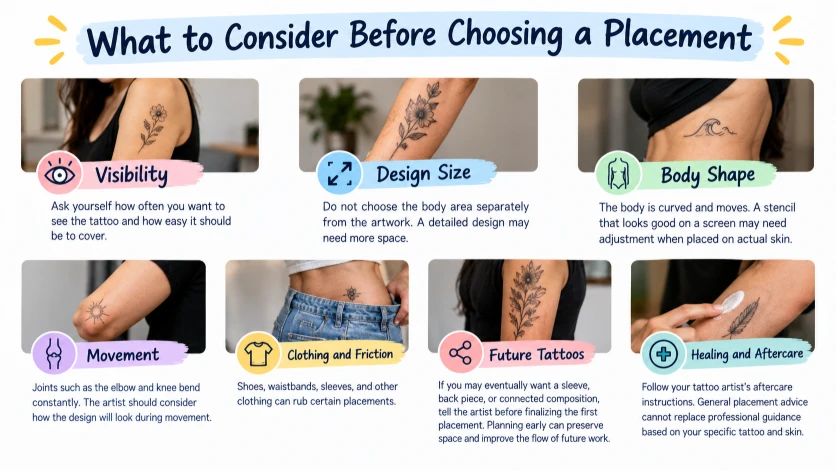
Visibility
Ask yourself how often you want to see the tattoo and how easy it should be to cover.
Design Size
Do not choose the body area separately from the artwork. A detailed design may need more space.
Body Shape
The body is curved and moves. A stencil that looks good on a screen may need adjustment when placed on actual skin.
Movement
Joints such as the elbow and knee bend constantly. The artist should consider how the design will look during movement.
Clothing and Friction
Shoes, waistbands, sleeves, and other clothing can rub certain placements.
Future Tattoos
If you may eventually want a sleeve, back piece, or connected composition, tell the artist before finalizing the first placement. Planning early can preserve space and improve the flow of future work.
Healing and Aftercare
Follow your tattoo artist’s aftercare instructions. General placement advice cannot replace professional guidance based on your specific tattoo and skin.
Tattoo Placement Names: Quick Reference
| Body area | Specific placement names | Often suits |
| Arm | Bicep, tricep, forearm | Medium designs |
| Wrist | Inner, outer, top | Small designs |
| Hand | Back, palm, fingers | Small bold designs |
| Shoulder | Cap, front, back | Curved designs |
| Chest | Pectoral, sternum, upper chest | Small to large designs |
| Back | Upper, mid, lower, spine | Large compositions |
| Neck | Front, side, nape | Small to medium designs |
| Ribs | Upper, lower, side ribs | Vertical or personal designs |
| Thigh | Front, inner, outer, back | Medium to large designs |
| Knee | Front, side, back | Designs adapted to movement |
| Calf | Inner, outer, back | Vertical designs |
| Ankle | Inner, outer, front | Small designs |
| Foot | Top, side, heel, toes | Small designs |
| Ear | Behind ear, lobe, cartilage | Tiny designs |
These are common descriptive terms, not strict universal categories. Tattoo studios may use slightly different wording.
Common Questions About Tattoo Placement Names
What’s a Good Placement for a Name Tattoo?
Popular choices include the forearm, wrist, chest, upper arm, shoulder, and collarbone. The best spot depends on visibility, size, and personal preference.
What Are 10 Common Tattoo Styles?
Ten common styles include traditional, neo-traditional, realism, fine line, minimalism, blackwork, watercolor, geometric, Japanese, and illustrative.
What’s the Most Painful Tattoo Placement?
Pain varies by person, but areas with thin skin and little padding, such as the ribs, spine, sternum, and feet, are often more sensitive.
What Is the Rule for Tattoo Placement?
There is no universal rule. Consider the tattoo’s size, design, visibility, body shape, workplace expectations, and how the artwork may change with aging.
What Is the Most Attractive Place for a Tattoo?
Attractiveness is subjective. The forearm, upper arm, shoulder, collarbone, and back are popular placements because they can complement the body’s natural shape.
What Is the Hardest Spot to Tattoo?
Areas with uneven surfaces, thin skin, or frequent movement can be challenging. Fingers, hands, elbows, knees, and feet may require extra care from the tattoo artist.
Conclusion
Tattoo placement names make it easier to talk about exactly where body art belongs. Instead of using broad terms such as “arm” or “leg,” you can identify a more precise area such as inner forearm, shoulder blade, sternum, outer thigh, calf, inner ankle, or nape.
The right placement depends on more than appearance. Consider the size and shape of your design, how visible you want it to be, how the area moves, how clothing interacts with it, and if you may want additional tattoos later.
For a first tattoo, it can help to bring a reference image and mark the exact area you have in mind. Your tattoo artist can then adjust the size, orientation, and placement to your individual anatomy.
There is no universal “best” tattoo spot. The useful question is if the design, body area, visibility, and long-term plan work together.
Know the placement name, show the exact area, and let the artwork follow your anatomy.
READ MORE!
Funny Work Group Chat Names: 150+ Ideas for Coworkers

I’m passionate about names, their meanings, origins, and cultural connections. I research naming trends and traditions to help readers discover unique, meaningful, and memorable names.








3 thoughts on “Tattoo Placement Names: 100+ Ideas for Every Body Area”